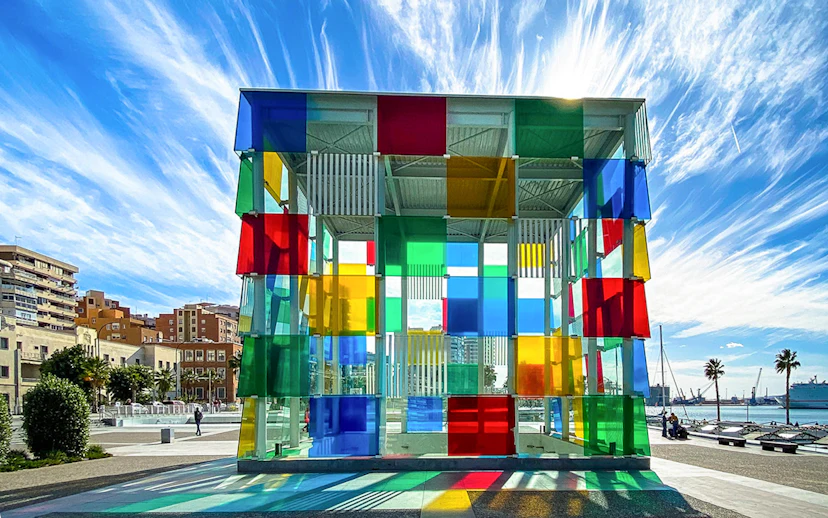
How to visit Centre Pompidou Málaga
Centre Pompidou Málaga is a waterfront branch of the Paris institution, best known for rotating semi-permanent hangs drawn from the Centre Pompidou collection rather than a fixed local collection. The visit is compact and easy to cover, but it works best if you understand the layout first: temporary spaces, lockers, and the youth workshop area are at entrance level, while the main collection galleries sit downstairs. This guide helps you time your visit, choose the right ticket, and avoid wasting time between levels.
Quick overview: Centre Pompidou Málaga at a glance
This is a manageable museum visit, but the right ticket and the right time slot make a noticeable difference.
- When to visit: Monday, Wednesday–Sunday, 9:30am–8pm; closed Tuesday except holiday Tuesdays and eves. Weekday mornings just after opening are noticeably calmer than Sundays after 4pm, because free entry starts then and the entrance-level galleries fill up quickly.
- Getting in: From €9 for the combined ticket, €7 for the semi-permanent exhibition only, and €4 for the temporary exhibition only; scheduled guided visits start from standard admission. Booking ahead matters most for free Sunday afternoons and major temporary shows, while regular weekday visits are usually more flexible.
- How long to allow: 1.5–2.5 hours for most visitors. You’ll be closer to the longer end if you see both exhibition strands, use the audioguide, or spend time in Espacio Público Joven.
- What most people miss: The entrance-level temporary galleries and youth workshop space are easy to skip because many visitors head straight downstairs to the collection galleries.
- Is a guide worth it? Yes if you want help understanding the thematic hang from Paris, but the multilingual audioguide is enough if you’d rather move at your own pace.
Jump to what you need
🕒 Where and when to go
🗓️ How much time do you need?
🎟️ Which ticket is right for you?
🗺️ Getting around
♿ Facilities and accessibility
Where and when to go
How do you get to Centre Pompidou Málaga?
Centre Pompidou Málaga sits on Málaga’s port waterfront in El Cubo, between Muelle 1 and Muelle 2, and it’s an easy add-on if you’re already exploring the old town or harbor.
Pasaje Doctor Carrillo Casaux s/n, 29016 Málaga, Spain | Open in Google Maps
- On foot: From the historic center → short waterfront walk → follow the marina promenade toward the colorful cube.
- Taxi / rideshare: Muelle Uno drop-off → 1–2 min walk → ask for El Cubo to avoid being left on the wrong side of the port.
- Cruise-port / waterfront access: Port promenade approach → direct arrival → useful if you’re already walking the harbor.
Which entrance should you use?
The museum uses a single public entrance through El Cubo, and the mistake most people make is heading downstairs immediately without checking whether the temporary exhibition or guided visit starts at street level.
- Main entrance: Located in El Cubo at Muelle Uno. Best for all visitors. Expect the longest waits on Sundays after 4pm, when free entry begins.
When is Centre Pompidou Málaga open?
- Monday: 9:30am–8pm
- Tuesday: Closed, except holiday Tuesdays and eves
- Wednesday–Sunday: 9:30am–8pm
When is it busiest? Sundays from 4pm to closing are the busiest because entry is free, and temporary exhibitions can also draw heavier midday traffic.
When should you actually go? Aim for Wednesday or Thursday between 9:30am and 11:30am, when the galleries feel roomier and the two-level route is easiest to do without backtracking.
Which Centre Pompidou Málaga ticket is best for you
| Ticket type | What's included | Best for | Price range |
|---|---|---|---|
Combined ticket | Semi-permanent exhibition + temporary exhibition | A first visit where you want the full museum rather than choosing one strand and missing the other | From €9 |
Semi-permanent exhibition ticket | Access to the long-term thematic hang from the Centre Pompidou collection | A shorter visit where you mainly want the core collection experience downstairs | From €7 |
Temporary exhibition ticket | Access to the current temporary show only | A return visit or a focused stop built around one headline exhibition | From €4 |
Scheduled guided visit | Admission + guided visit on selected Spanish or English slots | A visit where the thematic display will make more sense with structure and context from the start | From €9 |
How do you get around Centre Pompidou Málaga?
Layout and route
The museum is compact and split across two public levels, so it’s easy to self-navigate once you know that the entrance floor and the lower gallery floor serve different purposes.
- Level 0: Shop, lockers, temporary exhibition spaces, and Espacio Público Joven → allow 30–45 min.
- Level -1: Semi-permanent collection galleries drawn from the Centre Pompidou collection → allow 45–75 min.
Suggested route: Start on level 0 with the temporary show and public workshop area, then head down to level -1 for the main collection. Most visitors do the reverse, which is why they end up rushing the upstairs spaces at the end.
Maps and navigation tools
- Map: The visit is simple enough to do without a full printed plan, but it helps to think of it as street level first, collection level second.
- Signage: Wayfinding is straightforward once you’re inside, though the split-level setup can make visitors forget about the entrance-floor galleries.
- Audio guide / app: Audioguides are available in English, Spanish, French, German, Italian, and Russian, and they add real value because the hang is thematic rather than strictly chronological.
💡 Pro tip: Do not go straight downstairs just because the main collection is on level -1 — the easiest way to avoid backtracking is to finish the entrance-level temporary spaces first.
Where are the masterpieces inside Centre Pompidou Málaga?

Incubé
Creator: Daniel Buren
This is the work most people recognize before they even buy a ticket: the colored glass cube above the museum entrance. It’s worth slowing down for because it is not just a marker for the building, but a permanent in-situ artwork that shapes the museum’s identity on the waterfront. What visitors often rush past is how different the cube looks depending on the port light and your angle of approach.
Where to find it: Above the entrance at El Cubo, on the Muelle Uno waterfront side.
To Open Eyes / Miradas de artista
Format: Semi-permanent exhibition from the Centre Pompidou / Musée National d’Art Moderne collection
This is the museum’s core experience and the reason most visitors come. The display works as a thematic proposition rather than a simple ‘best of’ survey, so it rewards reading the room sequence instead of only stopping for the most familiar names. What people often miss is that the value lies in the curatorial argument between works, not just in individual pieces.
Where to find it: Level -1, in the main collection galleries.
El Gesto y la Materia. Abstracciones internacionales (1945–1965)
Format: Temporary exhibition
If you’re visiting while this show is on, it’s one of the strongest reasons to choose the combined ticket instead of the cheaper single-exhibition options. It matters because it expands the museum beyond a Pompidou-brand sampler and into a more focused art-historical visit. What many visitors miss is that the temporary show is often where the sharper, more concentrated curatorial storytelling happens.
Where to find it: Entrance level, in the temporary exhibition galleries.
Espacio Público Joven
Format: Changing exhibition-workshop space
This is not just a children’s corner; it’s one of the clearest signs that the museum treats mediation as part of the visit rather than an afterthought. It changes regularly, so even repeat visitors can find something different here. What people often miss is that it can make the whole visit more engaging, even if you’re not traveling with kids.
Where to find it: Entrance level, beside the public and family workshop area.
Facilities and accessibility
- 🎒 Cloakroom / lockers: Lockers are available on-site, which makes a light bag much easier than carrying extras through both levels.
- 🚻 Restrooms: Adapted toilets are available in the museum, so you don’t need to leave the building mid-visit to find one.
- 🍽️ Rest area and vending: There is a rest area with vending rather than a full sit-down café, so it works better for a quick pause than a meal.
- 🛍️ Gift shop / merchandise: The museum shop is on level 0, which makes it easiest to browse at the end of your visit.
- 🪑 Seating / rest areas: The rest area is the best place to pause between the temporary show and the downstairs collection route.
- 🤱 Lactation room: A lactation room is available, which is genuinely useful if you’re visiting with a baby.
- ♿ Mobility: Ramps, lifts, adapted toilets, and wheelchair service make the two public levels accessible, though you’ll rely on elevators to move between them.
- 👁️ Visual impairments: Audioguides are available in English, Spanish, French, German, Italian, and Russian, which helps if you prefer listening to interpretation rather than reading gallery texts.
- 🧠 Cognitive and sensory needs: The clearest route is to do level 0 first and level -1 second, because the museum is simple once you understand the order.
- 👨👩👧 Families and strollers: The lifts, adapted facilities, and lactation room make the museum manageable with a stroller on a short, well-paced visit.
Centre Pompidou Málaga works well for school-age kids and curious teens because the visit is compact, the building is memorable, and the museum includes dedicated mediation spaces.
- 🕐 Time: 60–90 min is realistic with younger children, and it’s smarter to prioritize one exhibition plus Espacio Público Joven than to stretch every gallery.
- 🏠 Facilities: Lockers, adapted toilets, lifts, and the lactation room make short family visits much smoother.
- 💡 Engagement: Start outside with Daniel Buren’s cube, then ask children to spot how color, shape, and visual tricks continue inside the galleries.
- 🎒 Logistics: Bring a small bag, not a bulky one, and aim for weekday mornings when the two-level route feels calmer and easier to manage.
- 📍 After your visit: Muelle Uno right outside is the easiest place to decompress after gallery time.
Rules and restrictions
What you need to know before you go
- Entry requirement: You can buy tickets online, and reduced or free-entry categories apply to several visitor groups, so bring any ID or proof needed for your rate.
- Bag policy: Lockers are available on-site, which is the easiest solution if you arrive with more than a small day bag.
- Dress note: There is no formal dress code, but light layers work best because you’ll move between the sunny port and air-conditioned galleries.
Not allowed
- 🚫 Food and drink: Keep food and drinks for the rest area or outside the galleries rather than carrying them through the exhibition rooms.
- 🚬 Smoking and vaping: Treat the museum interior as smoke-free and step back onto the port promenade if you need a break.
- 🐾 Pets: Leave pets outside unless they are service animals needed for access.
- 🖐️ Touching exhibits: Don’t touch artworks or installations unless a workshop space clearly invites it, especially because many works are on loan from Paris.
Photography
Photography is easiest to handle by following room signage instead of assuming one rule covers the whole museum. The exterior cube is the obvious photo stop, while temporary exhibitions may apply tighter rules inside. Keep flash, tripods, and selfie sticks out of the galleries unless a specific room clearly says otherwise.
Good to know
- Free Sunday window: Sundays from 4pm to closing are free for everyone, which is great for a quick look but usually the busiest slot for an unhurried visit.
- Guided visits: Scheduled guided visits in Spanish and English are included with admission, so check the day’s times before you head downstairs on autopilot.
Practical tips
- Book the combined ticket unless you’re truly short on time: At €9, it usually makes more sense than paying €7 or €4 for only one part of the museum and then realizing you wanted the other strand too.
- Use free Sunday hours carefully: Entry is free from 4pm on Sundays, but the museum closes at 8pm, so that slot works better for a shorter look than a slow full visit.
- Start on level 0, not level -1: Do the temporary show, workshop area, and practical stops first, then head downstairs to the semi-permanent hang so you don’t end up retracing your steps.
- Choose the audioguide if you want freedom without losing context: It’s available in 6 languages — English, Spanish, French, German, Italian, and Russian — and it suits the museum’s thematic displays well.
- Pack light even though lockers are available: A small bag still makes the compact galleries easier, especially if you’re moving between floors and stopping outside for photos of the cube.
- Eat before or after, not during: The on-site break option is a rest area with vending, so a proper meal is better planned around Muelle Uno rather than inside the museum.
What else is worth visiting nearby?
Museo de Málaga
- Distance: Short walk from the port
- Why people combine them: Visitors often pair them because they’re close together yet completely different in feel — Centre Pompidou Málaga for modern and contemporary art, and Museo de Málaga for archaeology and fine arts in the Palacio de la Aduana.
Alcazaba of Málaga
- Distance: Walkable from the waterfront
- Why people combine them: It makes sense as a same-day route because you can move from the port and modern art into one of Málaga’s strongest historic landmarks without changing neighborhoods.
Also nearby
- Málaga Cathedral
- Distance: Short walk from the museum
- Worth knowing: It fits best if you want to turn the visit into a broader old town and waterfront afternoon rather than another full museum stop.
Eat, shop and stay near Centre Pompidou Málaga
- On-site: The museum has a rest area with vending, which is fine for a quick pause but not worth treating as your main meal stop.
- Muelle Uno waterfront cafés: Short walk, Muelle Uno; good for coffee, light meals, and staying close to the museum without breaking your route.
- Historic center tapas bars: Short walk, central Málaga; better if you want stronger value and a proper sit-down meal after the museum.
- Port-side restaurants: Short walk, Muelle Uno; best if you want to linger by the water after a short cultural stop.
- 💡 Pro tip: Eat either before you enter or after you leave — the vending area is useful for a reset, but not for the kind of lunch that justifies stopping your visit.
- Museum shop: The best place for exhibition catalogs, art books, and design-led souvenirs, and it’s easy to visit on your way out from level 0.
- Muelle Uno shops: Useful if you want casual waterfront shopping after the museum without going back into the old town first.
Yes for a short city break, especially if you want the waterfront on one side and the old town within easy reach on the other. This area suits visitors who like being able to walk to culture, dining, and the marina without relying on transport. For a longer Málaga stay, it can feel more visitor-focused than neighborhood-based.
- Price point: The waterfront skews pricier than some inland parts of the city, though the convenience is hard to beat for a short trip.
- Best for: A brief Málaga stay where you want to combine museums, harbor walks, and easy evening dining on foot.
- Consider instead: Stay deeper in the historic center for more atmosphere and easier access to tapas bars, or look farther inland if you want a less tourist-facing base.
Frequently asked questions about visiting Centre Pompidou Málaga
Most visits take 1.5–2.5 hours. That is usually enough for the semi-permanent display downstairs, the temporary exhibition upstairs, and a short stop in Espacio Público Joven. If you use the audioguide or join a scheduled guided visit, you’ll get more from the museum by planning closer to the longer end.
No, you usually don’t need to book far ahead for a regular weekday visit. Advance booking matters more for free Sundays after 4pm and for strong temporary exhibitions, when the compact entrance level can feel crowded faster than visitors expect.
Arrive around 10–15 minutes early. That gives you enough time for ticket checks, lockers, and a quick look at the entrance-level layout before deciding whether to start with the temporary galleries or head downstairs.
Yes, but it’s smarter to keep it small. Lockers are available on-site, which helps if you arrive with more than a light day bag and don’t want to carry extra weight through both gallery levels.
Yes, but photo rules can change by room and exhibition. The cube exterior is the easiest place to photograph freely, while temporary exhibitions may apply stricter conditions inside. Check signage in each gallery, and don’t count on flash, tripods, or selfie sticks being allowed.
Yes, group visits are possible. The museum also has a strong mediation program for schools and other organized groups, and scheduled guided visits help if you want more structure than a self-guided visit provides.
Yes, especially for families who want a manageable museum rather than a full half-day cultural marathon. The building is compact, the colorful cube is an easy hook for children, and Espacio Público Joven adds a more interactive layer to the visit.
Yes, the museum has ramps, lifts, adapted toilets, and wheelchair service. The public route is split across 2 levels, so you’ll use elevators between floors, but the museum is set up to make that workable.
Yes, but the on-site option is limited. Inside the museum there is a rest area with vending, while the better food options are on Muelle Uno and in the nearby historic center, both of which are easy to fold into the same outing.
Yes, entry is free on Sundays from 4pm to closing. It’s a good option if you want a shorter, lower-cost visit, but it’s also the busiest time of the week, so it is rarely the calmest way to experience the galleries.
Audioguides are available in 6 languages: English, Spanish, French, German, Italian, and Russian. They’re especially useful here because the museum’s semi-permanent displays are thematic, so extra context helps the rooms connect more clearly.
Start on level 0. That lets you cover the temporary galleries and public workshop area first, then move down to level -1 for the semi-permanent collection without having to come back upstairs in a rush.