
Plan your visit to Málaga Cathedral
Málaga Cathedral is a Renaissance-Baroque church best known for its unfinished second tower and soaring, light-filled interior. The visit itself is manageable rather than exhausting, but it rewards attention: the choir stalls, side chapels, and neighboring Sagrario are easy to rush past if you treat it as a quick photo stop. Timing matters most in the late morning, when walking tours and old-town foot traffic pile up outside. This guide helps you plan arrival, timing, tickets, and what to prioritize once you’re inside.
Quick overview: Málaga Cathedral at a glance
- When to visit: Monday–Friday 10am–6:30pm and Saturday 10am–6pm are the easiest sightseeing windows; the first hour after opening is noticeably calmer than late morning, when old-town walking tours and cruise-day foot traffic spill into Plaza del Obispo.
- Getting in: From €10 for standard entry. Guided visits start around €15, and booking ahead matters most in Holy Week, summer weekends, and for any rooftop-related slot when it reopens.
- How long to allow: 1–1.5 hours works for most visitors, and it stretches closer to 2 hours if you use the audio guide properly or add the VR rooftop experience.
- What most people miss: The carved choir stalls and the Iglesia del Sagrario are the two spaces most often skimmed, even though both add far more character than another fast lap of the nave.
- Is a guide worth it? Yes, if you want the cathedral explained in the context of Málaga’s wider history; if you mainly want architecture and time to linger, the included audio guide is usually enough.
🎟️ Guided tour slots for Málaga Cathedral are limited in Holy Week and on summer weekends. Lock in your visit before the time you want is gone. See ticket options
Jump to what you need
🕒 Where and when to go
🗓️ How much time do you need?
🎟️ Which ticket is right for you?
🗺️ Getting around
⛪ What to see
♿ Facilities and accessibility
Where and when to go
How do you get to Málaga Cathedral?
The cathedral sits in Málaga’s compact historic center, a short walk from Plaza de la Marina and Málaga-Centro Alameda, so the final stretch is easiest on foot.
Address: Calle Molina Lario, 9, 29015 Málaga, Spain | Find on Google Maps
- Train: Málaga-Centro Alameda → 12-minute walk → easiest route is along Alameda Principal and up Calle Larios.
- Bus: Pasillo de Santa Isabel → 5-minute walk → useful if you’re coming from María Zambrano station or western neighborhoods.
- Taxi/rideshare: Plaza de la Marina drop-off → 5-minute walk → the streets immediately around the cathedral are pedestrian-only.
Which entrance should you use?
There is one main visitor entrance, but queues separate by how you’re entering, and that’s where people lose time. Most walk-ups join the first line they see instead of checking whether online and guided visitors are being filtered separately.
- Pre-booked tickets and guided visits: For timed-entry visitors and tour groups. Expect 5–15 minutes during busy summer mornings.
- On-the-day ticket line: For walk-up visitors and upgrades. Expect 20–40 minutes in late morning, especially on weekends and cruise-heavy days.
When is Málaga Cathedral open?
- Monday–Friday: 10am–6:30pm
- Saturday: 10am–6pm
- Sunday and holy days: Sightseeing hours are more limited around services
- Last entry: Give yourself at least 45 minutes before closing if you want more than a quick circuit
When is it busiest? Late morning to early afternoon is the pinch point, especially in summer and during Holy Week, when the plaza, ticket line, and central nave all feel more congested.
When should you actually go? Aim for the first hour after opening on a weekday, when the central aisle is quieter and you can study the choir and main chapel before group tours thicken.
How much time do you need?
| Visit Type | Time Required | What you get |
|---|---|---|
Highlights Only | 30-45 minutes | Focus on the main nave and choir for a quick overview. Ideal if you're short on time. |
Balanced Visit | 1–1.5 hours | Explore the main nave, choir, main chapel, and a few side chapels for a rewarding experience. |
Full Exploration | 1.5-2 hours | Enjoy the complete experience, including all chapels and the VR rooftop, using the audio guide effectively. |
Select your experience
Málaga Cathedral and Surrondings Guided Walking Tour
Cover the Malaga's Historic cathedral with entry to the cathedral interior and key sites surrondings the cathedral.
- Everything you get: Walk for 1.5 exploring the area surrounding the the cathedral like Bishop square and St. Mary street and passing sites such as Santiago Church. Finish with included entry to the city cathedral, where you can step inside, view the nave and chapels, and understand its role in the city's story.
- Why choose this: Use this tour as an early stop in your trip so you quickly get oriented and plan deeper visits later.
- Options: Choose an English or Spanish guided tour to suit your language needs.
Inclusions #
1.5-hour tour of Málaga
Entry to the Cathedral of Málaga
Guided tour in English or Spanish (as per option selected)
Exclusions #
- Hotel transfers
Accessibility
- Wheelchair access: The tour route and the Cathedral of Málaga are wheelchair accessible.
- Get full refund if you cancel 24 hours before the experience start time.
Which Málaga Cathedral ticket is best for you
| Ticket type | What's included | Best for | Price range |
|---|---|---|---|
1.5-Hour Guided Tour of Málaga and the Cathedral of Málaga | Expert guide in English or Spanish + guided walk through Málaga historic center + entry to the Cathedral of Málaga | A shorter visit where you want cathedral context and a city-center walk without committing half a day. | |
3-Hour Guided Tour of Málaga with Roman Theater, Alcazaba & Cathedral Tickets | Expert English or Spanish-speaking guide + personal wireless audio guide system + entry to the Roman Theater + entry to the Alcazaba + entry to Málaga Cathedral | A deeper half-day route when you want Málaga’s Roman, Moorish, and Christian layers explained in one logical walk. |
How do you get around Málaga Cathedral?
Getting around Málaga Cathedral
Málaga Cathedral is best explored on foot and is comfortably coverable in 45–90 minutes, though the visit slows down if you use the audio guide or linger in the chapels. The main nave opens straight ahead from the entrance, with the choir occupying the center and the chapels wrapping around the outer edge.
- Main nave and choir: The visual heart of the cathedral with the carved stalls and organ → budget 15–20 minutes.
- Main chapel: The grand liturgical focal point with the altar and apse → budget 10 minutes.
- Side chapels: A ring of quieter devotional spaces with altarpieces and sacred art → budget 15–20 minutes.
- Iglesia del Sagrario: The neighboring historic chapel with a different, older feel → budget 10–15 minutes.
- VR rooftop experience: The easiest way to grasp the building’s scale when physical rooftop access is closed → budget 10 minutes.
Suggested route: Start with the central nave and choir before groups cluster there, continue clockwise through the chapels, then finish with the Sagrario outside so you don’t accidentally skip it once you leave the main route.
Maps and navigation tools
- Map: Your audio-guide route is the most useful navigation tool here, because it gives you a numbered sequence rather than just a floor plan.
- Signage: Basic wayfinding is enough for the main spaces, but it’s easy to miss the Sagrario or rush the chapels without an audio route.
- Audio guide/app: Multilingual audio guides are included with standard entry and add real value here because labels inside are limited.
💡 Pro tip: See the choir before you do the outer chapels — once the late-morning groups gather in the center, it becomes the hardest space to enjoy slowly.
What are the most significant spaces in Málaga Cathedral?

Plaza del Obispo façade and north tower
Attribute — Era: 18th century façade over a 16th-century cathedral build
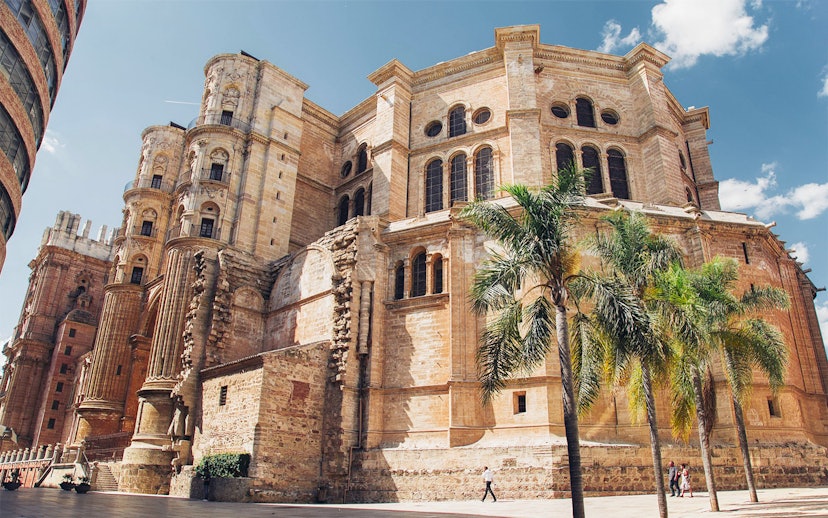
The exterior is where the cathedral’s nickname makes immediate sense: one bell tower rises fully, while the matching tower was never finished. Most visitors photograph the front and move on, but it’s worth slowing down for the marble columns, sculpted saints, and the asymmetry that makes La Manquita feel local rather than overly polished.
Where to find it: The main façade on Plaza del Obispo, before you enter
The main nave and double-height columns
Attribute — Era: Renaissance interior with later Baroque enrichment
This is the space that resets your sense of scale the moment you walk in. The height, filtered light, and rhythm of the columns do most of the work, but what many visitors miss is that the upper sections were extended to make the interior feel even more graceful and vertical than originally planned.
Where to find it: Directly ahead of the entrance, running the full length of the cathedral
The choir stalls
Attribute — Creator: Pedro de Mena and José Micael Alfaro
The choir is the cathedral’s real slow-down point. Even visitors who come for the architecture end up lingering here because the carved mahogany stalls are dense with saints, prophets, foliage, and small details that reward a close look. Most people admire it from one angle only; walk all the way around, because no two stalls feel exactly alike.
Where to find it: In the center of the nave, enclosed within the main visitor route
The main chapel
Attribute — Era: Renaissance with later Neoclassical and Baroque layers
The main chapel gives the building its liturgical focus and one of its calmest sightlines. Visitors often glance at it after the choir and keep moving, but the real payoff is looking up into the apse and dome area, where the scale and decoration make more sense together than they do in fragments.
Where to find it: At the far eastern end of the cathedral, beyond the choir
Iglesia del Sagrario
Attribute — Era: Late Gothic, earlier than the main cathedral body
This smaller neighboring church feels older, darker, and more intimate than the cathedral next door, which is exactly why it stands out. Many visitors miss it because they assume the visit ends at the cathedral exit, but its Gothic portal and gilded altarpiece give you the clearest sense of the site’s longer religious history.
Where to find it: Outside the main cathedral, on the north side, accessed separately but within the same immediate complex
The rooftop perspective and VR experience
Attribute — Experience type: Panoramic viewpoint / immersive interpretation
When rooftop access is open, it’s one of the best urban views in Málaga. When it isn’t, the VR experience still helps you understand the cathedral as a whole rather than as a series of interior rooms. What people often miss is that the rooftop view is not just about scenery — it makes the unfinished tower and the cathedral’s massive roofline finally click.
Where to find it: Via the dedicated rooftop route when operating, or through the on-site VR experience area
Facilities and accessibility
- 🎧 Audio guide pick-up: Audio guides are part of the standard visit and are the main way most visitors get context without joining a live tour.
- 🚻 Restrooms: Restrooms are near the exit, and there is an accessible toilet available on-site.
- 🛍️ Gift shop / merchandise: There is a small retail area near the exit for postcards, guidebooks, and religious souvenirs.
- 🪑 Seating / rest areas: Benches inside the cathedral make it easy to pause without leaving the main route.
- 🕶️ 360º VR experience: The upgraded visit can include a VR interpretation of the rooftop, which is especially useful when physical roof access is suspended.
- 🌡️ Indoor comfort: The cathedral interior stays cooler than the surrounding old-town streets, which makes it an easier midday stop in warmer months.
- ♿ Mobility: The main floor is accessible via a step-free side entrance, the aisles are wide, and the rooftop route is not accessible because it requires a stair climb.
- 👁️ Visual impairments: The audio guide is the most useful support here because it delivers spoken context in multiple languages throughout the visit.
- 🧠 Cognitive and sensory needs: The first hour after opening is the calmest window, while late morning is the most stimulating because tour groups and old-town noise peak at the same time.
- 👨👩👧 Families and strollers: The main floor is manageable with a stroller, but the rooftop component is stair-only and should be treated as a separate decision.
Málaga Cathedral works well with children if you keep the visit short and visual — the scale, organ, choir carvings, and tower story give them enough to focus on without needing a long art-history lesson.
- 🕐 Time: Around 45–60 minutes is realistic with younger children, and the choir plus the main nave are the easiest priorities.
- 🏠 Facilities: Benches and accessible restrooms make it easier to pause, reset, and avoid turning the visit into a forced march.
- 💡 Engagement: Ask children to spot the unfinished second tower outside, then look for carved faces and animals around the choir inside.
- 🎒 Logistics: Bring a small bag, arrive early before the plaza gets crowded, and skip the visit’s longest explanatory stops if attention drops.
- 📍 After your visit: The Roman Theater and the lower approach to the Alcazaba are close enough for a second stop without another long transit leg.
Rules and restrictions
What you need to know before you go
- Entry requirement: Pre-booking is the smoothest option in summer and Holy Week, though ordinary weekdays are usually flexible enough for a same-day visit.
- Bag policy: Bring a compact day bag rather than bulky luggage, because the old-town approach is pedestrian-heavy and a lighter bag makes entry simpler.
- Dress guidance: This is an active religious space, so respectful clothing works best, especially if you may overlap with worship hours.
Not allowed
- 🚫 Food and drink: Save snacks and drinks for before or after the visit and use the cafés around Plaza del Obispo instead.
- 🚬 Smoking and vaping: Smoke and vape outside the cathedral precinct only.
- 🐾 Pets: Pets should stay outside, while assistance animals are the practical exception.
- 🖐️ Touching artworks: Don’t touch the choir woodwork, altarpieces, or devotional objects, because they are historic and still in active religious use.
Photography
Photography is generally fine for personal use in the visitor areas, but keep it discreet and respectful. The practical line is simple: don’t let your camera interrupt worship, avoid flash around sacred art and darker chapel spaces, and leave tripods or bulky selfie gear out of a visit that moves through narrow circulation points.
Good to know
- Rooftop access: If rooftop views matter to you, check availability before you go because restoration work can change what is visitable.
- Service overlap: Tourist access and worship can share the same building, so the atmosphere can shift quickly from sightseeing to quiet observance.
Practical tips to make the most of your visit
- Booking and arrival: Book 2–3 days ahead for summer weekends or Holy Week if you want a guided visit, and arrive 10–15 minutes early so you’re not stuck sorting tickets in Plaza del Obispo once the late-morning queues build.
- Pacing: See the choir as soon as you enter, because it’s the first space to feel crowded, even though the cathedral as a whole still seems roomy.
- Crowd management: The best window is a weekday right after opening, when the cathedral is quieter, and the old-town streets outside haven’t yet filled with walking tours and cruise-day foot traffic.
- What to bring or leave behind: Carry a small bag only; the surrounding center is easiest on foot, and you’ll move through the visit more comfortably without extra layers or shopping bags.
- Food and drink: Eat before or after rather than planning a break in the middle, because the visit is short and the most convenient cafés around the cathedral are in a pricier, more tourist-heavy pocket.
- If you want the fuller route: The 3-Hour Guided Tour of Málaga with Roman Theater, Alcazaba & Cathedral Tickets works best when you’re fresh in the morning, not as a late-afternoon add-on after a full walking day.
What else is worth visiting nearby?
Commonly paired: Alcazaba of Málaga
Distance: 300m — 5-minute walk
Why people combine them: They tell two different chapters of Málaga’s history in one compact route, and the walk between them is so short that it feels like one continuous cultural stop.
Learn more
✨ Málaga Cathedral and Alcazaba of Málaga are most commonly visited together — and simplest to do on a combo route. The 3-Hour Guided Tour of Málaga with Roman Theater, Alcazaba & Cathedral Tickets keeps all three major historic stops in one logical walk. → See combo options
Commonly paired: Roman Theater
- Distance: 350m — 5-minute walk
- Why people combine them: It is right below the Alcazaba approach, so it adds a Roman layer to the same part of the city without forcing extra transit or backtracking.
Also nearby
Picasso Museum Málaga
Distance: 400m — 6-minute walk
Worth knowing: The Picasso Museum is the best nearby add-on if you want your day to shift from sacred and historic architecture to Málaga’s most internationally recognizable artist.
Paseo del Parque and the port waterfront
Distance: 200m — 3-minute walk
Worth knowing: This is the easiest decompression stop after the cathedral if you want shade, sea air, and an unfussy walk instead of another museum immediately after.
Eat, shop and stay near Málaga Cathedral
- On-site: There is no real café inside the cathedral, so the quickest fallback is the terrace cluster around Plaza del Obispo, which is convenient but usually pricier than nearby side streets.
- Casa Lola (5-minute walk, C. Granada, 46): Classic tapas, moderate prices, and fast turnover make it a reliable post-visit stop when you don’t want a long sit-down. | Find on Google Maps
- El Pimpi (6-minute walk, C. Granada, 62): Traditional Andalusian dishes and Málaga wine in a much more atmospheric setting if you want the meal to feel like part of the outing. | Find on Google Maps
💡 Pro tip: Eat either before 12:30pm or after 2:30pm if you want to avoid the busiest lunch crush in the streets between the cathedral and Calle Granada.
- Cathedral gift shop: Small religious souvenirs, postcards, and guidebooks near the exit if you want something directly tied to the visit.
- Calle Larios: Málaga’s main shopping street is about 3 minutes away and is the easiest option for fashion, sweets, and practical last-minute purchases.
- Atarazanas Market: A better stop for edible souvenirs than general retail, especially if you want local produce, cured goods, or a quick market detour on the way back.
Yes, if your trip is short and you want to walk everywhere. The old town gives you the easiest access to the cathedral, the Alcazaba, restaurants, and the port, but it is also one of the busier and noisier parts of Málaga. For longer stays, some travelers prefer a neighborhood with a little more breathing room.
- Price point: This area skews mid-range to premium, with the best-value exceptions usually found on smaller streets rather than the cathedral-facing plazas.
- Best for: Short city breaks, first-time visitors, and anyone who wants to step out of their hotel and reach the cathedral in under 10 minutes.
- Consider instead: Soho works better if you want a slightly calmer base with strong food options, while La Malagueta suits travelers who want beach time built into the same trip.
Frequently asked questions about visiting Málaga Cathedral
Most visits take 1–1.5 hours. That is enough time for the nave, choir, main chapel, and the Sagrario if you move at a normal pace. If you use the audio guide properly or add the VR rooftop experience, you can stretch the visit to almost 2 hours without it feeling padded.
No, you do not always need to book far ahead, but it helps in summer, on weekends, and during Holy Week. Standard visits are usually flexible on ordinary weekdays, while guided experiences are the first to tighten up. If you want a fixed time without waiting around in the plaza, pre-booking is the better call.
Yes, it can be worth it in late morning during summer and on busier religious weeks. This is not a site with extreme all-day queues, but the wait can still eat into a short old-town itinerary when walking tours and cruise-day traffic arrive together. If your schedule is tight, faster entry is useful.
Arrive 10–15 minutes early. That gives you enough buffer to sort your ticket, collect any included audio material, and find the right line without turning a short visit into a rushed one. If you arrive much later than your slot, you may still get in, but you lose the best part of timed entry: a smoother start.
Yes, but keep it small. A compact day bag is easy to manage inside the cathedral and through the pedestrian old town around it. Bulky luggage is a bad fit for this visit even before you reach the entrance, because the surrounding streets are busy, narrow, and much easier to handle lightly packed.
Yes, personal photos are usually fine in the main visitor areas if you keep them discreet. The practical rule is to avoid turning photography into an obstruction: skip flash, don’t crowd worshippers or chapels, and leave bulky tripods or large selfie gear out of a site that is still an active religious space.
Yes, and it works especially well as part of a wider historic-center route. If you want more context than a self-guided visit gives, group experiences on Headout already pair the cathedral with nearby stops. The 3-Hour Guided Tour of Málaga with Roman Theater, Alcazaba & Cathedral Tickets is the strongest option for a broader half-day overview.
Yes, as long as you keep the visit focused and relatively short. Most children respond better to the scale of the space, the unfinished tower story, and the carved choir than to a long chapel-by-chapel explanation. About 45–60 minutes is usually the sweet spot before attention starts to drop.
Partly, yes. The main floor can be accessed step-free through the side entrance, and the interior aisles are wide enough for a comfortable visit. The limitation is the rooftop route, which is stair-only. If the view matters to you, the VR experience is the best alternative because it gives context without the physical climb.
Yes, there are plenty of places to eat nearby, but not really inside the cathedral itself. Plaza del Obispo is the fastest convenience option, while the surrounding streets give you better-value tapas and more interesting sit-down choices within 5–10 minutes on foot. It is better to eat before or after rather than mid-visit.
There is no Vatican-style screening setup, but you should still dress respectfully because this is an active church. That matters most if your visit overlaps with worship hours. Clothing that feels fine for the beach can feel out of place here, so a light layer and generally modest attire are the safest choice.
Yes, but your visit will feel different. During services, the building shifts from sightseeing mode to worship, which means some areas may feel quieter, more restricted, or less comfortable for lingering with a camera. If your priority is the fullest visitor experience, choose a standard sightseeing window rather than service time.